Cybersecurity Awareness Month: 5 Essential Measures for UAE Businesses


Five Measures Every UAE Business Should Be Able to Demonstrate
October is Cybersecurity Awareness Month, but awareness alone does not protect a business.
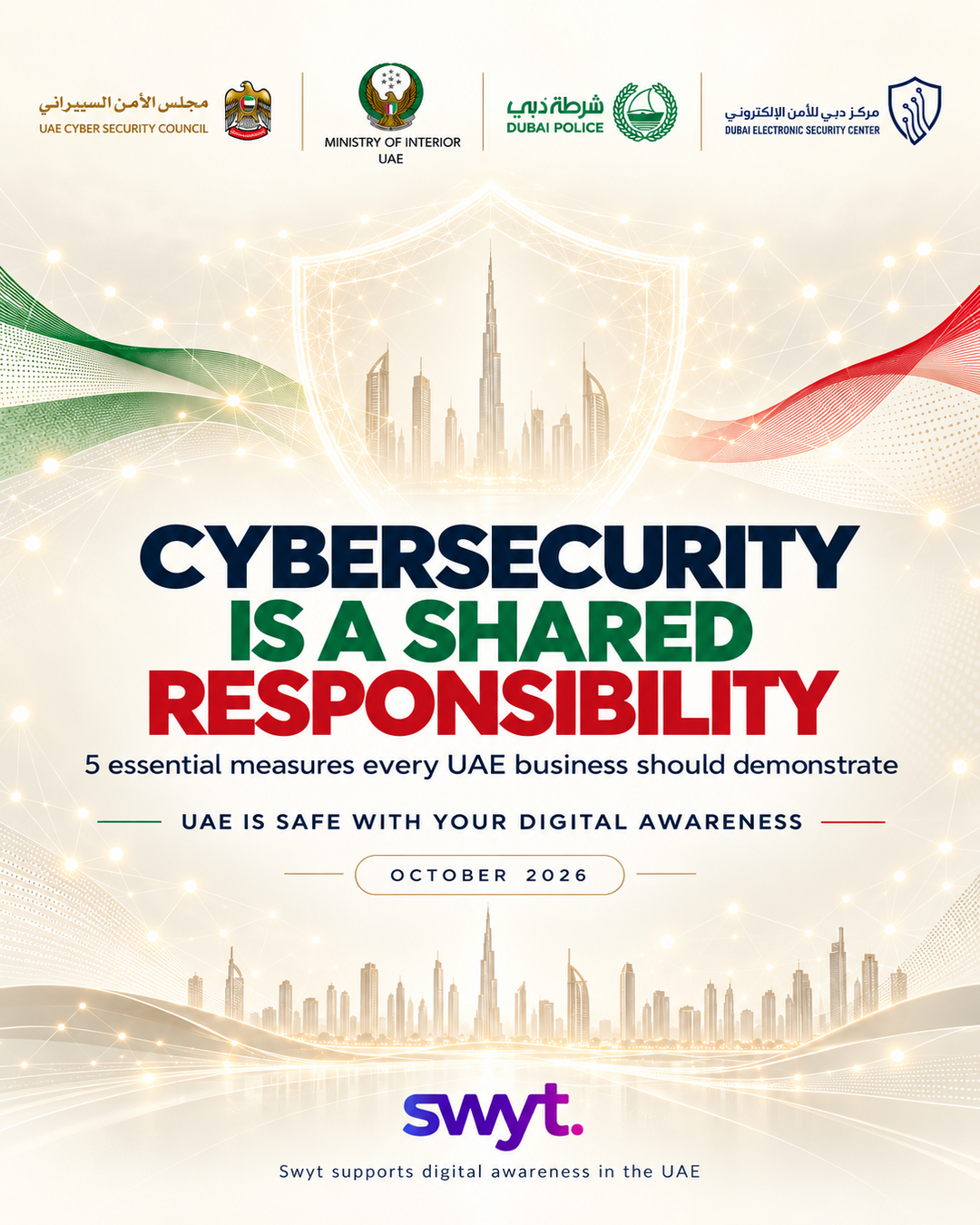
This year, the UAE Ministry of Interior, Dubai Police General Headquarters and the Dubai Electronic Security Centre launched the “UAE is Safe With Your Digital Awareness” campaign to strengthen awareness of electronic and cybercrime across society.
The initiative comes as cybercriminals increasingly use artificial intelligence and sophisticated impersonation techniques to make fraudulent messages, payment requests and login pages more convincing.
For businesses, the message is particularly important: cybersecurity is not only the responsibility of the IT department or an external provider. It requires coordinated action from management, IT teams and every employee with access to company systems.
A strong cybersecurity foundation starts with five essential measures.
1 Enable Multi Factor Authentication and Control Access
A password alone is no longer enough to protect a business account.
Multi-factor authentication adds another verification step when employees access systems such as Microsoft 365, Google Workspace, accounting platforms, CRMs and cloud applications.
However, enabling MFA is only the beginning. Businesses should also be able to demonstrate that:
- MFA is enforced across all critical applications
- Access is granted according to each employee’s role
- Administrator privileges are tightly controlled
- Suspicious login attempts are monitored
- Former employees’ access is revoked immediately
- Employees know never to approve an unexpected MFA request
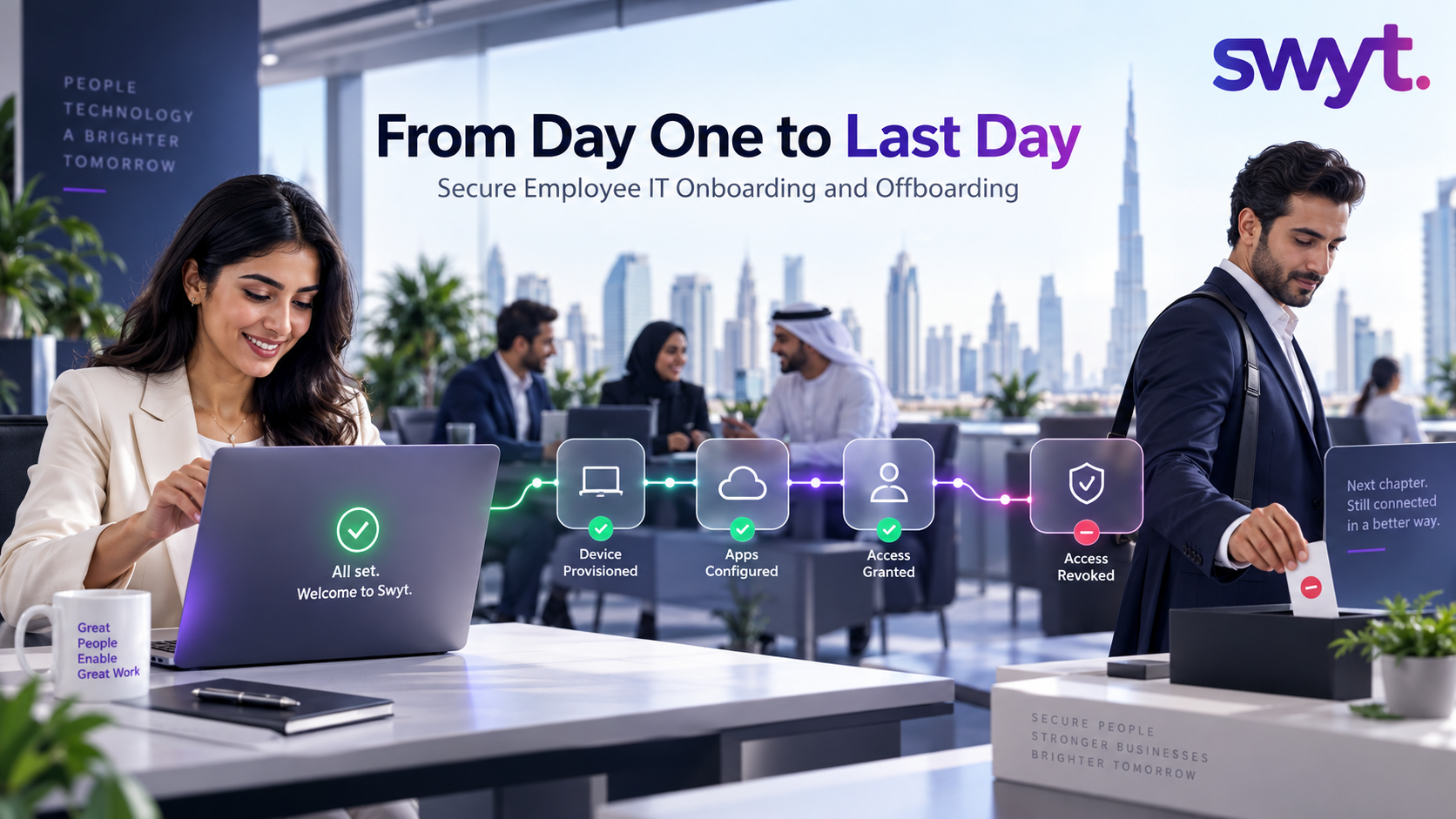
Access management should cover the entire employee lifecycle. When somebody joins, changes roles or leaves the company, their permissions must be updated consistently across every system.
Swyt’s cloud-security services help businesses enforce MFA, password policies, session controls and access rules across Microsoft 365, Google Workspace and other cloud applications.
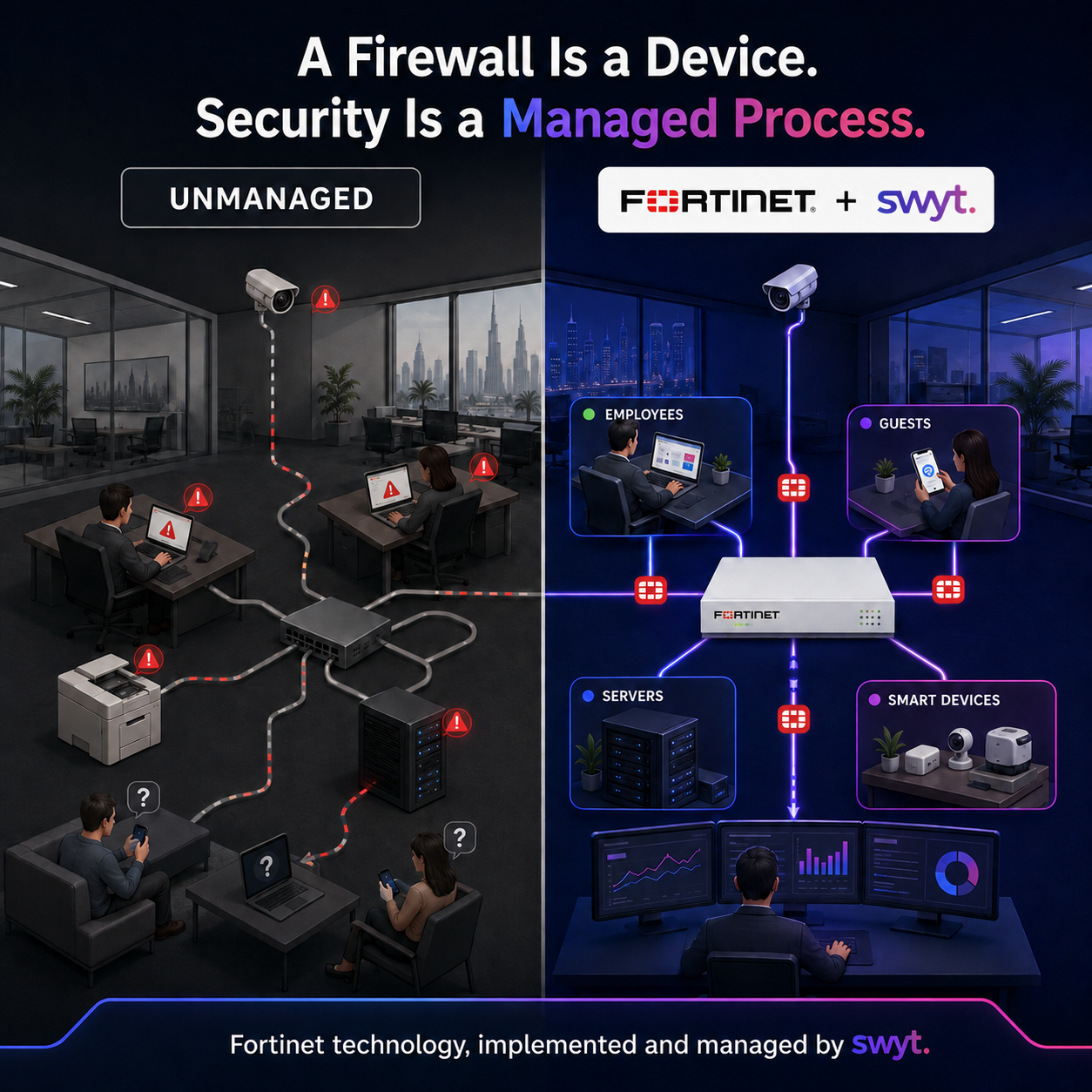
2 Secure the Company Network and Firewall
The business network connects employees, laptops, servers, printers, CCTV systems and cloud services. If it is poorly configured, one compromised device can create a much larger security problem.
A secure network should include:
- A professionally configured and managed firewall
- Intrusion prevention and threat detection
- Separate corporate and guest Wi-Fi networks
- Secure remote access and VPN controls
- Strong wireless encryption
- Monitoring for unknown or unauthorised devices
- Regular firmware and security updates
Installing a firewall is not enough. Its rules must be reviewed, updated and monitored as the organisation changes.
Swyt provides managed network security, including firewall management, intrusion prevention, secure Wi-Fi segmentation, VPN deployment and real-time infrastructure monitoring.
3 Protect Every Laptop Phone and Server
Employees work from offices, homes, airports, customer locations and shared spaces. Company information therefore travels far beyond the traditional office network.
Every device that can access business data should be centrally protected and managed. This includes:
- Endpoint protection and threat detection
- Mobile device management
- Operating-system and application patching
- Disk encryption
- Security-policy enforcement
- Asset and device inventory
- Remote device locking or wiping
- Monitoring for outdated or high-risk devices
Businesses should also consider personally owned devices. If employees access company email, files or applications from unmanaged laptops and phones, those devices become part of the company’s risk exposure.
Through device management and MDM, Swyt helps businesses monitor and secure laptops, phones and tablets using platforms such as Microsoft Intune, Hexnode and Jamf Pro.
4 Back Up Your Data and Test Whether You Can Recover It
Having a backup and being able to recover the business are not necessarily the same thing.
Backups may be incomplete, outdated, incorrectly configured or accessible from the same environment affected by ransomware. Businesses often discover these problems only after data has already been lost.
An effective backup and recovery process should answer five questions:
1. What information is being backed up?
2. How frequently does the backup run?
3. Where are the backup copies stored?
4. Who can access or delete them?
5. When was the last successful recovery test?
The process should cover cloud data as well as local infrastructure. Using Microsoft 365, Google Workspace or another SaaS platform does not automatically provide a complete independent backup strategy.
Swyt’s data-security services combine backup and recovery planning with encryption, access controls, data-loss prevention and protection across devices, cloud applications and servers.
5 Train Employees to Identify and Report Cyber Threats
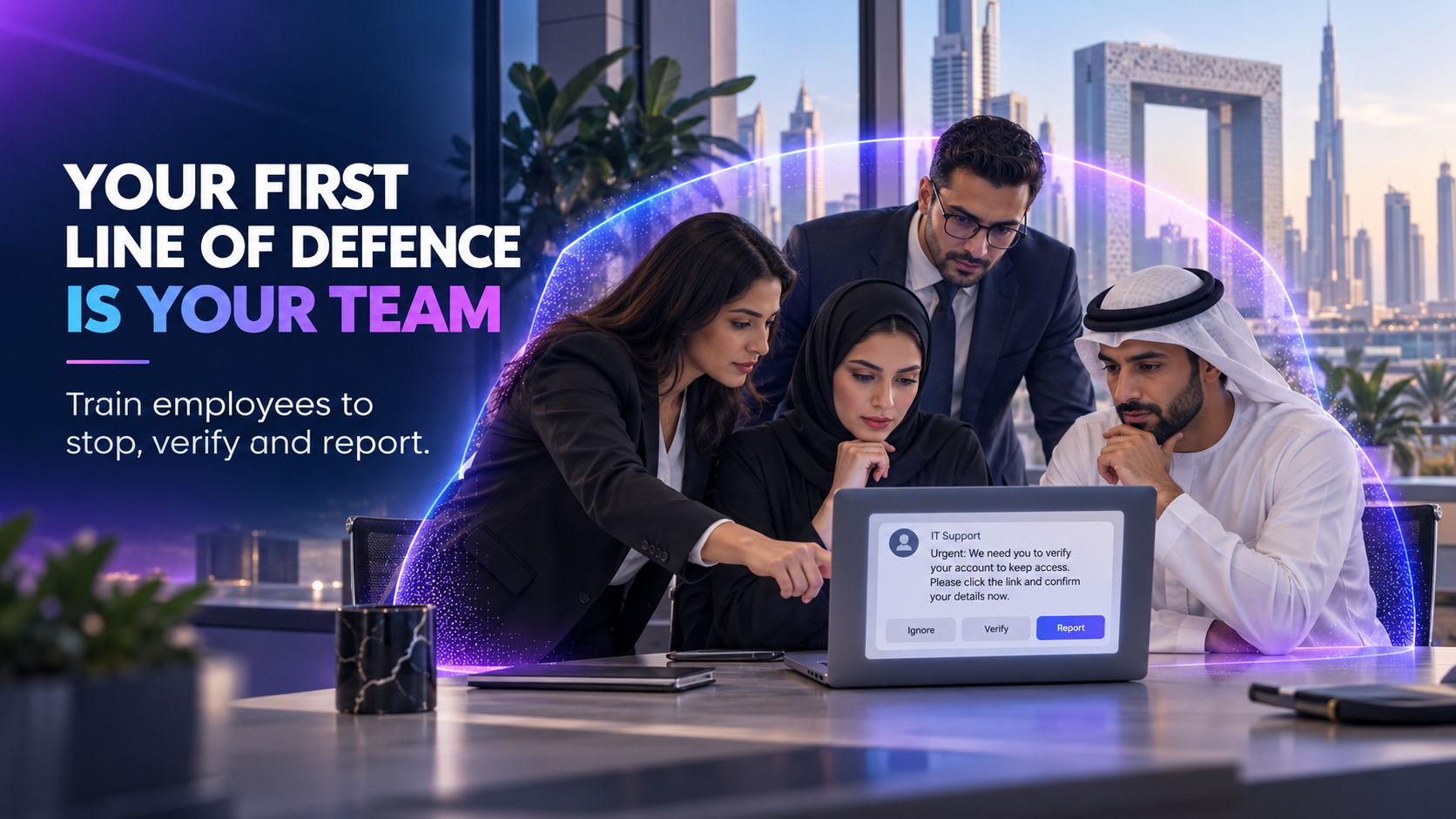
Technology can block many attacks, but employees will still encounter suspicious emails, messages, telephone calls and payment requests.
The objective of awareness training is not to turn every employee into a cybersecurity specialist. It is to help people make safer decisions during everyday situations.
Employees should learn how to recognise:
- Phishing emails and fake login pages
- CEO and executive impersonation
- Fraudulent supplier-payment requests
- Unexpected MFA notifications
- Requests for passwords or verification codes
- Social engineering through WhatsApp or telephone calls
- Suspicious QR codes, shared files and cloud links
- AI-generated voices, images and messages
Training should also explain exactly how employees can report something suspicious. A person who identifies a potential attack but does not know whom to contact cannot help the business respond quickly.
Swyt’s cybersecurity-awareness training includes role-based learning, phishing simulations, assessments, progress tracking and audit-ready completion certificates. The programme can be adapted to the company’s policies, systems and most relevant risks.
What Shared Responsibility Means in Practice
Shared responsibility does not mean that every employee becomes personally responsible for the company’s entire cybersecurity environment.
It means that each part of the organisation has a clearly defined role:
- Management establishes priorities, assigns ownership and provides sufficient resources.
- IT and security teams implement controls, monitor systems and respond to threats.
- Managers make sure processes are followed within their departments.
- Employees follow security procedures, verify unusual requests and report suspicious activity.
- Technology partners maintain the environment, identify weaknesses and provide specialist support.
Employees cannot compensate for missing MFA, unpatched devices or a poorly configured firewall. Equally, even strong technical controls can be undermined if employees are not prepared for a convincing impersonation or social-engineering attempt.
Effective cybersecurity therefore combines technology, processes and informed people.
Can Your Business Demonstrate These Five Measures Today
Cybersecurity Awareness Month is a useful opportunity to test whether essential protections are genuinely in place.
Ask your team:
- Is MFA enforced across every critical business application?
- Can we immediately identify and disable a former employee’s access?
- Who manages and reviews our firewall configuration?
- Can we see which company devices are encrypted and fully updated?
- When did we last successfully restore data from a backup?
- Do employees know how to recognise and report a suspicious request?
- Who is responsible for responding when a security incident occurs?
If the answer to any of these questions is unclear, that uncertainty should become a priority.
Cybersecurity is not a one-month campaign or a checklist completed once a year. It is an ongoing business discipline that protects operations, customer trust and the organisation’s ability to continue working.
Strengthen Your Cybersecurity Foundation with Swyt
Swyt helps businesses across Dubai, the UAE and the GCC protect their users, devices, applications, networks and data through one integrated managed-IT and cybersecurity service.
Our services include:
- Managed endpoint protection
- MFA and identity-security enforcement
- MDM, encryption and remote device control
- Firewall and network-security management
- Email and phishing protection
- Backup and recovery planning
- Real-time monitoring and incident response
- Cybersecurity-awareness training
- IT risk assessments and compliance support
Book a cybersecurity assessment with Swyt to identify your most important risks and define a practical action plan for your business.