ISO 27001 vs DFSA Cyber Rules: Do You Need Both?



For financial firms operating in the DIFC, one question comes up repeatedly: if we achieve ISO 27001 certification, are we automatically compliant with the DFSA Cyber Risk Management Rules?
The short answer is no.
ISO/IEC 27001 and DFSA GEN 5.5 address many of the same security risks, but they serve different purposes. ISO/IEC 27001 is an international standard for establishing, maintaining and continually improving an Information Security Management System (ISMS). Organisations can implement it with or without seeking formal certification. DFSA GEN 5.5 sets regulatory cyber-risk obligations for Authorised Persons within its scope.
ISO 27001 can provide a strong foundation. It does not remove the firm’s responsibility to identify and implement the DFSA-specific requirements that apply to it.
THE ESSENTIAL DIFFERENCE
ISO/IEC 27001 is a voluntary international management-system standard used by organisations across sectors. Certification is an option. DFSA GEN 5.5 is a regulatory requirement for the Authorised Persons to which it applies. It addresses the firm’s cyber-risk management, governance, controls and incident obligations.
The DFSA does not prescribe one specific cybersecurity framework or standard. Its guidance recognises standards and frameworks such as the ISO/IEC 27000 family, NIST Cybersecurity Framework and CIS Critical Security Controls. Whatever approach a firm selects must still meet the applicable DFSA rules and suit the nature, scale and complexity of its business.
The practical aim is to use the ISMS as an operating foundation, then map the DFSA requirements into it.
DOES THE DFSA REQUIRE ISO 27001 CERTIFICATION?
No. The DFSA does not mandate ISO 27001 certification as the only route to an appropriate cyber-risk framework. A firm can use a different framework, or a tailored combination of standards and controls, provided it meets the rules that apply to it.
ISO 27001 can still make the work easier to organise. It gives the firm a structured way to manage risk, assign responsibility, document policies, review controls, track corrective actions and improve over time.
Swyt’s ISO 27001 and regulatory compliance support can help connect the management system to the technical controls and operating evidence needed in practice.
WHERE ISO 27001 AND DFSA GEN 5.5 OVERLAP
Governance and accountability
Both approaches rely on clear ownership. A firm should know who owns cyber risk, who operates controls, who reviews performance and who can make decisions during a serious incident.
GEN 5.5 places ultimate responsibility for effective cyber-risk management on the firm’s Governing Body and senior management. The board needs useful information about risk and control performance, not only a list of technical alerts.
Risk assessment
An ISO 27001 ISMS identifies and treats information-security risks. The DFSA also expects firms to identify cyber threats, assess controls, understand residual risk and consider potential impacts on the business.
A shared risk method can support both, provided it includes the firm’s critical operations, ICT assets, dependencies and regulatory exposure.
Asset and data visibility
A business cannot protect systems it has not identified. Both programmes depend on visibility across devices, servers, applications, cloud platforms, networks, user accounts, sensitive information, suppliers and critical business processes.
Centralised device management and IT asset tracking can provide evidence of ownership, encryption, patching, configuration and security status.
Technical security controls
The two approaches support a risk-based selection of controls. For many growing businesses, the practical set includes multi-factor authentication, role-based access, endpoint protection, patch and vulnerability management, network security, encryption, backup and recovery, logging and monitoring, secure configuration and security-awareness training.
Swyt’s managed cybersecurity services bring these controls together across users, devices, applications and infrastructure.
Cloud and application security
Microsoft 365, Google Workspace, cloud infrastructure and SaaS applications belong within the control environment. Moving systems to the cloud does not remove the firm’s responsibility for access, configuration, data protection and monitoring. Cloud-security controls can enforce MFA, conditional access, secure configurations and monitoring across hosted systems.
Monitoring and improvement
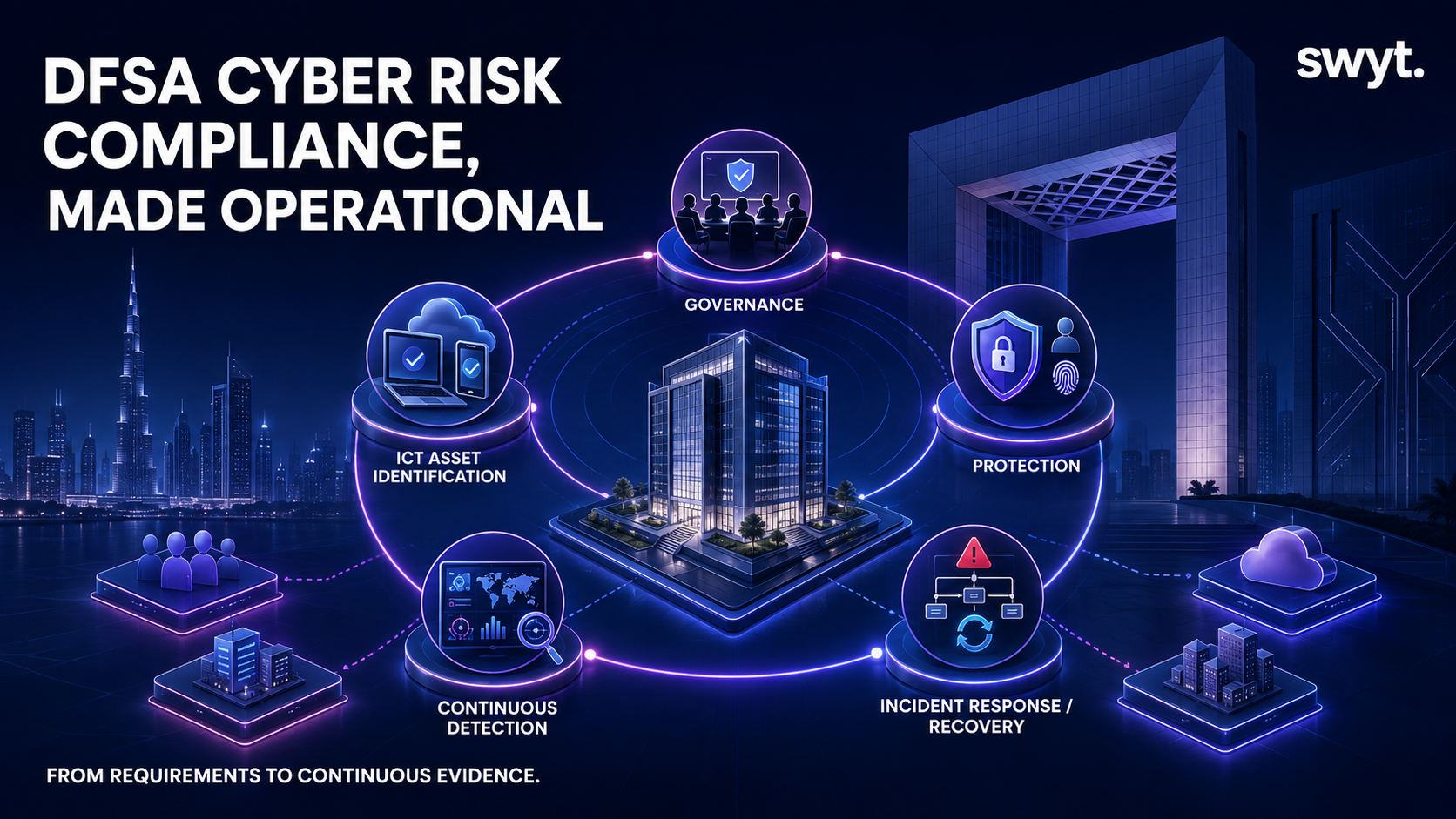
An effective programme must show that controls keep working after implementation. Useful evidence may include security alerts and incident records, access reviews, device-compliance reports, patch and vulnerability reports, backup tests, supplier reviews, internal-audit findings, risk-treatment actions and management-review records.
The DFSA’s supervisory approach considers governance, cyber hygiene and cyber resilience.
WHAT ISO 27001 CERTIFICATION DOES NOT AUTOMATICALLY COVER
The scope of the DFSA obligation
An ISO certificate applies to a defined ISMS scope. If that scope excludes a business unit, system, supplier or location relevant to the firm’s DFSA obligations, the certificate cannot demonstrate that the excluded area is adequately controlled. Compare the certified scope with the regulated activities and ICT dependencies.
DFSA-specific governance
A functioning ISMS may still lack the specific Governing Body oversight, cyber-risk tolerance, management information or decision authority expected under GEN 5.5. These responsibilities should be mapped and evidenced.
Regulatory incident notification
GEN 5.5.19 requires an Authorised Person to notify the DFSA as soon as reasonably practicable and no later than 72 hours after it becomes aware, or has information reasonably suggesting, that a material cyber incident has occurred.
An ISO-certified incident process does not automatically include DFSA materiality criteria, the internal regulatory decision owner, access to the DFSA electronic portal, approval steps, evidence of when the notification clock may have started or a process for later updates. These steps need to be addressed explicitly.
Regulatory supervision and evidence
Certification demonstrates conformity with a selected standard and scope through the certification process. DFSA compliance must operate continuously. A firm should be able to show how controls work through current reports, records, decisions and remediation actions.
Data-security and audit-trail controls can help create evidence across access, sharing, encryption, information handling and data-protection activities.
HOW TO BUILD ONE INTEGRATED PROGRAMME
1. Confirm regulatory applicability
Confirm whether the organisation is a DFSA Authorised Person and which Rulebook requirements apply. Being incorporated or located in the DIFC does not, by itself, mean every company has the same DFSA obligations.
2. Define the technology scope
Document the users, devices, applications, cloud platforms, networks, information, suppliers and locations that support the regulated business. Compare this inventory with the formal ISMS scope.
3. Map GEN 5.5 against the ISMS
Create a working matrix that records each applicable DFSA requirement, its supporting ISO process or control, the owner, available evidence, identified gaps, remediation actions and next review date. This helps prevent two disconnected compliance programmes.
4. Close DFSA-specific gaps
Give particular attention to Governing Body responsibilities, cyber-risk tolerance, critical-operation mapping, third-party cyber risk, monitoring, incident materiality, regulatory notification, recovery, communication and management reporting.
5. Make evidence part of daily IT operations
Create evidence through normal operations instead of collecting it just before an audit. Examples include device reports, access-review records, support tickets, backup-test results, security alerts, supplier assessments and remediation logs.
6. Review and test the programme
GEN 5.5 requires the Cyber Risk Management Framework to be reviewed periodically and at least annually. Consider changes in the business, technology, suppliers, threats and regulatory requirements.
ONE CONTROL ENVIRONMENT, TWO OUTCOMES
ISO 27001 and DFSA GEN 5.5 should reinforce each other. ISO 27001 provides a structured management system. The DFSA rules add specific governance, supervisory and regulatory outcomes for Authorised Persons.
When mapped properly, the firm can reduce duplicate policies, assessments and evidence collection. It can use one operating framework to support certification, regulatory compliance and stronger day-to-day security.
ISO 27001 can support DFSA compliance. It does not certify that a firm has satisfied every DFSA obligation.
FAQS
Does ISO 27001 certification satisfy DFSA GEN 5.5?
Not automatically. ISO 27001 provides a strong information-security management foundation, but the firm must separately map and implement applicable DFSA governance, operational, incident-response and notification requirements.
Does the DFSA require every Authorised Person to obtain ISO 27001 certification?
No. The DFSA does not mandate one specific cybersecurity standard. The firm must implement an appropriate Cyber Risk Management Framework that meets the applicable rules.
Does every company in the DIFC need to comply with GEN 5.5?
No. Being located or incorporated in the DIFC does not automatically make a company a DFSA Authorised Person. Each business should confirm its regulatory status and applicable requirements.
Can the same evidence support ISO 27001 and DFSA compliance?
Yes. Risk assessments, access reviews, asset inventories, incident records, control reports and management reviews can support both when they address the relevant scope and requirements.
Does ISO certification remove the DFSA 72-hour incident-notification requirement?
No. A regulated firm must maintain its own DFSA-specific materiality, escalation and notification process regardless of its certification status.
Should a DIFC financial firm start with ISO 27001 or DFSA compliance?
An Authorised Person should first identify its regulatory obligations. ISO 27001 can then structure the wider management system and supporting controls.
Can Swyt issue an ISO 27001 certificate?
Swyt can support gap assessment, ISMS implementation, technical controls, documentation and audit preparation. Formal certification must be performed by an independent certification body.
Already ISO 27001 certified but unsure whether your environment meets DFSA expectations?
Swyt can map your existing ISMS and technical controls against GEN 5.5, identify missing evidence and build a practical remediation plan across users, devices, applications, infrastructure and security.
Request an ISO 27001 and DFSA readiness review.